

The best-written recent release
And John Grindrod answers our questions on prose style


Every week we identify the best-written works of fiction, speculative fiction, or nonfiction from recent releases and shortlists for major prizes, and from our subscribers’ submissions. We also publish articles by their authors on prose technique and AI writing, and for paid subscribers the best-written book of the month.
THE NEW YORK TIMES BOOK REVIEW EDITORS' CHOICE
Uncle Johnny knew. Mike Labella knew. My aunt Ceil knew, and so did my uncle Harry, my mother’s brother. My father’s surviving sisters—Liz, Ellie, Millie—all knew, and had known pretty much all their lives. Mr. Rudolph, our next-door neighbor, might not have known, but his wife, Ina, sure did. My older cousins Billy and Betty Ann knew, because of what their parents told them, and my younger cousins Mitchell and Michael knew because my father told them himself, when he was regaling them with his stories, which is to say when he was telling them his secrets.
And what about me? Well, I knew better than anyone else at the service, indeed anyone else alive—my father, after all, had told me, and so, in her way, had my mother. But at the same time I knew as little as my brother did, which was nothing at all. I knew, but I couldn’t tell, and because I couldn’t tell, I couldn’t see. And I’m not speaking metaphorically, either. I mean that when the one person who not only knew about my father’s double and triple life but had tasted it walked into the funeral parlor, she remained invisible to me. How could I not have seen her?
Read more»
The nonfiction titles considered this month are here.
Information about submitting to Auraist is here. Our standards are as high as for our other picks, but if we publish your work, we’ll invite you to answer our questions on prose style. Your answers will be considered for inclusion in the print publication of these answers by many of the world’s best writers.
Please consider completing our reader survey, to help shape Auraist in the future.
The Demon Inside David Lynch»
We have got hysterical on the subject of Twin Peaks: The Return. Red-faced, wide-eyed, squeaky-voiced. Our tone when discussing it was sometimes panic-stricken or worse. None of us has experience with anything as historically unusual as this, anything this abnormal, let alone how you’re supposed to talk about it. Even so, we still weren’t too panicked for the subject matter. I insist on that. Just because you’re paranoid doesn’t mean they’re not out to get you, and just because you’re panicked doesn’t mean this atrocity doesn’t deserve it.
Read more at the link below.

Guides to prose style»
‘There’s something joyless about cheating at games. AI creative writing might look impressive – an instant word count, something approximating the brief – but no-one has ever inhabited this writing.’
John Grindrod is the author of Concretopia: A Journey Around the Rebuilding of Postwar Britain (2013), Outskirts: Living Life on the Edge of the Green Belt (2017) and Iconicon: A Journey Around the Landmark Buildings of Contemporary Britain (2022). He hosts a podcast, Monstrosities Mon Amour.
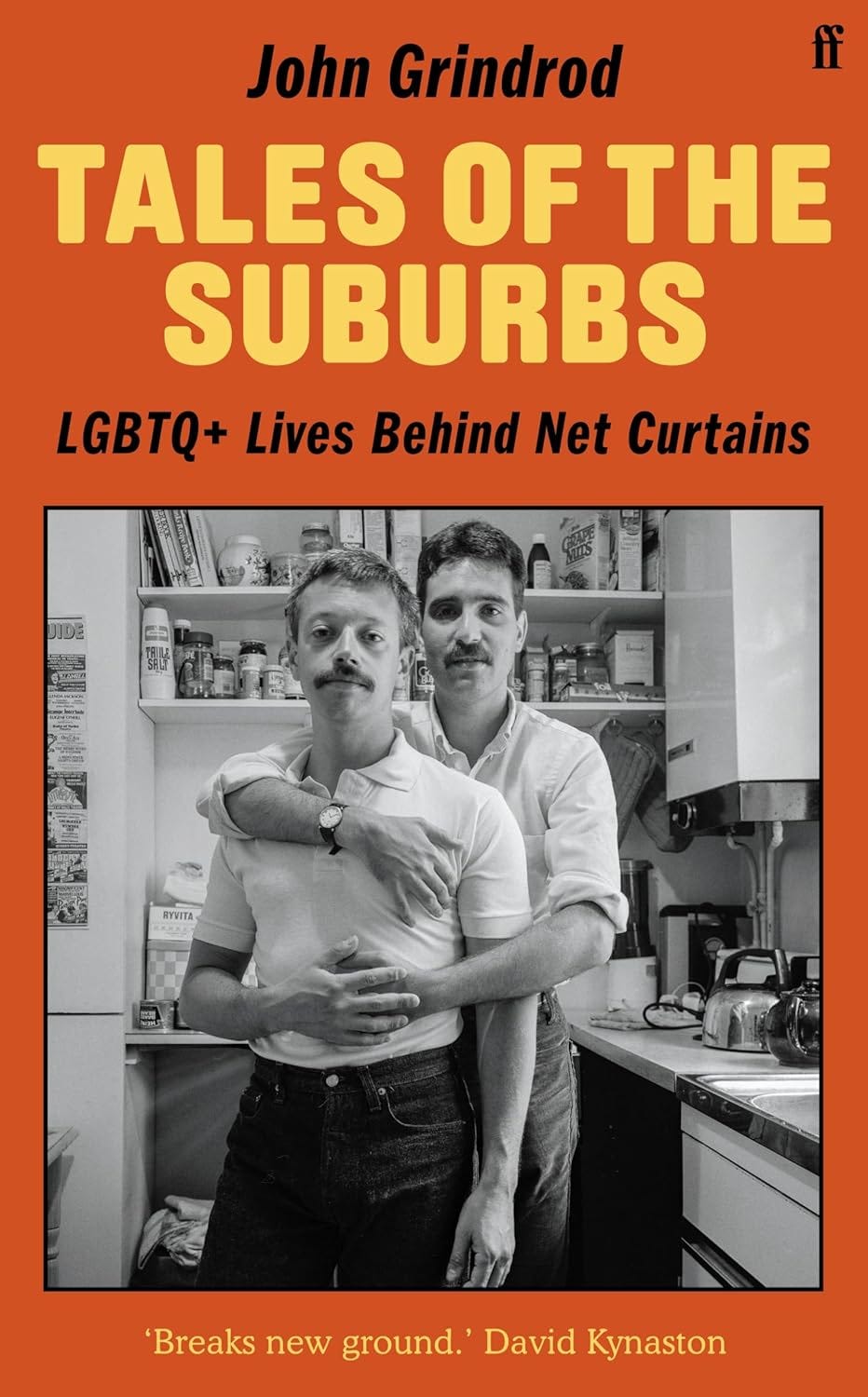
We chose his nnew book, Tales of the Suburbs: LGBTQ+ Lives Behind Net Curtains as a best-written recent release.
In your early writing career, were there writers whose sentences permanently affected the standards of your reading and your own writing aspirations? Could you tell us some lessons you learned about prose style from these writers?
Alan Bennett was always the writer who most captivated me when I was starting out. How the stories emerged from unpromising situations and what he called ‘dull lives’. Attempting to put ordinariness onto the page – in all of its extravagant extraordinariness – was something I really tried to emulate in all my writing.
The way he’d elevate simple domestic situations and routines to give them a sense of something more profound going on in the background, his use of everyday language limiting the kind of moods and feelings expressed, the way that those limitations would then craft the world of the story, I found all of that really inspiring.
Without being prompted to copy the style, could AI ever write as well as such writers?
The main thing about AI writing is what’s the point? And I suppose the answer is the promise of money for nothing. But given how so few of us ever make any money from writing in the first place, it’s almost worth suggesting AI spend its digital life slogging away alongside us on unmarketable books too. At least it would be keeping it out of trouble.
There’s something joyless about cheating at games. AI creative writing might look impressive – an instant word count, something approximating the brief – but no-one has ever inhabited this writing. It didn’t need writing and because of that it won’t need reading too. It’s not a ghost, because no-one was ever there.
The best writing has a flicker of awkwardness to it, a moment that captures what it is to be human not through its perfection but through its flaws. The rest might be easy to replicate, the neatness of functional prose, even a certain by the rules lyricism. But those original notes of minor failure or unexpected transcendence are unlikely to stem from a few commands and a prompt.
Which stylistic issues mattered most when you were writing and editing TALES OF THE SUBURBS?
The biggest issue for me with Tales of the Suburbs was how to unify so many different voices, be they interviewees of different ages, genders and sexualities, or words taken from archive sources.
One way was to bring all of the stories into the present tense. This was partly to reduce the gap between the reader and the events being described. Things happening in 1910 should have the same urgency as those happening now, without the ‘sepia’ of past tense.
The other factor was to unify the stories with my voice as storyteller. I chose not to become invisible, but to be a participant in the book. This allowed me to highlight moments I felt were funny, or absurd, or frightening, for example.
Allowing myself to comment on the stories while telling them meant that it added some sense of flow to the prose, and unified the experience of reading it without flattening out the stories and the individual voices themselves.
Continues below.
‘Clarity in non-fiction is overrated. We are writing, we’re not simply sharing data. Your book is not a spreadsheet with pretensions.’
To what extent, if any, do you favour showing over telling?
Showing not telling is one of those things that feels true, but I’m not sure we all agree on what it actually means, or are bound by the same rules.
Some writers are able to slide and dodge through pages of telling, while equivalent passages for the rest of us would render a book dead on arrival. It depends on the showing and the telling.
Mindless action tells us nothing. For me, a more useful distinction is telling and withholding. Leaving space for the reader is what makes either showing or telling work.
Everything can be spelled out either in action or description. But by holding back, reducing the information of either, the reader can find themselves in the midst of the story. Too much information for storytellers means not grisly oversharing of personal details, it’s killing prose with a completist vision.
The paradox is, you need to have the vision to be able to write the scene, but you also need to share the sparest of details to make it come to life.
The one stylistic quality you can never overdo is clarity. Do you agree?
Clarity in non-fiction is overrated. We are writing, we’re not simply sharing data. Your book is not a spreadsheet with pretensions. What data needs is completion. What writing needs is space. I don’t mean space as in word count, I mean the space between moments and ideas, the beats that allow a penny to drop. Good writing should suggest as much as it defines.
Muddy non-fiction is a glorious thing. Take All the Devils Are Here, David Seabrook’s bracing and sometimes psychedelic stroll through the history of three Kentish places. The prose teeters on the edge of informative and overwhelmed.
Meanwhile in W.G. Sebald’s The Rings of Saturn, the writer feels much more assured and in control of the narrative, but is what we’re being told here the truth? There’s a clarity to the storytelling, but also, as with Seabrook, a sense that logic goes in and out with the tide. So what we’re being told is not always a clear point.
It’s easy to confuse the clarity of language with the desire to only tell thoughts that are verifiable. It’s the weight of data on the non-fiction writer, something that needs shrugging off at every opportunity. Ambiguity is much more fun than clarity, and usually feels more like our experience of the world, because so little of what we encounter really makes sense.
Is there anything else you’d like to tell aspiring writers about prose style?
Writing about style is a bit like becoming aware of your own breathing, it’s both inhibiting and worrying. What if I forget how to do it? And more than that, how did I ever manage? Was the whole thing a trick, knowledge that could disappear as quickly as it came?
In some senses writing is a trick, a confidence trick. Confidence is a trick between you and the words. It is to writing what surface tension is to water boatmen.
Some writers are extraordinarily good at self-consciousness. Not just those embarked on autofiction, where being conscious of your self is part of the job description. Others unravel every thought and sentence they have committed to the page almost as soon as they are down.
Take Ali Smith, whose writing constantly explores her joy at language and the gap between it and our experience of the world. It means that her writing is playful and questioning, luring readers into traps where meaning and answers are never easily discerned. Her writing is sustained by her style because her restless interrogation of language and syntax is forever generating new ways of breaking open the world in small, nagging ways.
Her writing is about the surface as much as it is about the space behind and in front, like a painter playing with the picture plane, perspective and depth. As a reader this is so rewarding, because her writing diverts into asides and deconstruction that add much more than a straightforward narrative could.
Our archive has over fifty author articles on prose style and AI writing, hundreds of picks from recent releases and prize shortlists, and the best-written books of the century. A paid subscription gives you full access to this archive, and to the best-written book of the month posts, and allows you to submit your own work to Auraist.
Thanks for reading and helping to support fine writing.
Sean McNulty
